Every question, one page.
31 answers, grouped by what you are actually worried about: what it costs, whose AI it uses, what it can build, where it runs, who can see what, and what you own. If an answer here disagrees with a page elsewhere, tell us and we will fix the page.
Pricing and the meter
What's the catch?
You pay your AI provider directly — Claude, ChatGPT, whichever you already use. We never meter it, mark it up, or resell it. The organization license covers the platform: the backend, the environments, the governance. That is the whole arrangement.
Do my live apps cost anything to run?
No. Production traffic on your apps is not metered, and your license covers hosting on the managed cloud infrastructure we operate. Metered tools bill you while you build, and some keep billing while your app runs — the mechanics, vendor by vendor, with sources and dates, are on how the meter works. The limits that do exist are written down: the Acceptable Use Policy and your license agreement, with no usage meter behind them.
Is there a per-seat or per-builder charge?
No. One organization license covers every builder in your organization, every app they build, and every environment those apps run in. Adding a builder is an invitation, not an invoice.
What does the organization license cost?
Pricing is set per organization and confirmed on a call, because the right shape depends on how many teams and tenants you run — not on how many prompts you type. Talk to us and you will have a number quickly. Use the calculator to compare it against a realistic year on a metered tool.
Is there a trial or a pilot?
Access is invite only, and the invite conversation is the pilot conversation: request an invite and we scope a first solution around a real use case, so you evaluate working software rather than a sandbox. Bring your IT lead; the security questions get answered in the same session.
We are an agency. Can one license cover many client apps?
Yes. Unlimited apps and unlimited builders sit under one organization license, and the platform is multi-tenant: one account can serve many tenants with row-level data isolation. See agencies for how the economics work.
What happens if we cancel?
Your data is yours: every object is a real table you can export through the documented API, and custom frontends are ordinary repositories you already hold. Platform-built apps stop running when the license ends, because they run on the platform — so take your data out before then, and ask for the export window and the assistance we give to be written into your agreement before you sign. The full answer is on Do I own my apps?
Bring your own AI
What AI do I need?
Any subscription that can drive an MCP-capable agent. Claude Code is the path we test and document first; other MCP clients connect the same way. The desktop app connects your agent to the platform's control surface of named operations, and you are building.
Do you see my prompts?
Your prompts go to your AI provider under your account. What reaches our platform is the sequence of named operations your agent decides to run — create-object, add-field-to-form, commit-solution-edit — each authenticated as you. We record tool invocations for audit and quality; we are not a party to your conversation with the model.
Which models work best?
Any model good enough to run an agent that follows tool descriptions. The platform teaches your agent its conventions in-band through get-domain-knowledge and per-tool hints, so a capable model becomes productive without a human explaining the platform.
What if the AI does something dumb?
On platform apps it cannot introduce code at all — it can only call named, guarded operations, with your permissions, and a solution can be frozen against AI edits entirely for a human-only window. Edits are staged in a transaction: preview-solution-edit shows an entity-level diff before commit-solution-edit writes once, and an unattended transaction rolls itself back after sixty seconds. Custom frontends are the deliberate exception — there the agent writes ordinary Vite/React, and every deployment is versioned and rolls back per environment.
Building
Does the AI generate my app's code?
For platform apps, no — that is the point. The agent assembles your app from governed platform primitives (objects, forms, workflows, grids, screens) through named operations, so there is no pile of generated backend code to review and maintain. Where you want a custom frontend, the agent does write ordinary Vite/React code, and it ships through the same versioned pipeline.
What kinds of apps can I build?
The categories that ship on the platform today: field-service and inspection apps, checklist and compliance apps, CRM-style apps, workflow automation and multi-step approvals, data-entry and public intake forms, business processes with PDF generation and external system calls — plus custom React frontends and dashboards over the same data. See use cases and blueprints.
Do apps work on mobile?
Platform apps render in the platform's web and mobile renderer, and field-service patterns — offline mode, location tracking, photo and signature capture — are part of what ships today. There is no native app-store build: the renderer is how a platform app reaches a phone. Custom frontends are whatever you build them to be.
Can humans and agents work on the same app?
Yes, safely. Platform solutions are edited through the same named operations whether a person or an agent is calling them, with one open transaction per solution at a time. Custom-frontend working copies use a single-writer edit session, so an agent and a person never clobber each other's files.
Environments and deploy
What environments do I get?
Custom frontends promote through develop, staging, and production — a strict one-way chain with role-gated promotion and per-environment rollback. Platform apps publish from a working copy to testing and production snapshots, with frozen backup snapshots for branching. Every push is one click; there are no pipelines to write.
Where do my apps run?
On managed cloud infrastructure we operate, built primarily on AWS. You do not provision servers, write deploy pipelines, or hire DevOps — dev, staging, production: one click each. The backend is not self-hostable.
How does rollback work?
Rollback is non-destructive: it creates a new deployment that points at the previous successful version and moves the environment head there, so the audit trail is preserved. Promotion to production and production rollback are owner-only actions.
Security and IT
How is access controlled?
Every request to the platform carries a bearer token validated on every call; an unauthenticated request receives a bare 401 with no server details. The AI acts with your permissions — the token is forwarded and the platform authorizes, so an agent can never do more than the person running it. Groups gate screens, actions, and grids server-side.
How is customer data isolated?
Row-level: every object table carries a tenant column and queries are filtered on it automatically; every data write requires an explicit tenant context. Isolation is at the data layer within your account, not dedicated infrastructure per customer — we say so plainly.
Do you have SOC 2 or ISO 27001?
We publish an honest status page rather than badges we have not earned: see compliance for what is available today, what is in progress, and what is available on request (security overview, DPA, subprocessors).
How long has this platform been around?
CodeMonster.ai is built by Knomatic on the platform that has carried enterprise workloads for twelve years. The AI-native control surface is new; the backend under it is not.
Ownership
Do I own my apps?
Your data is yours, always. Custom frontends are standard Vite/React you can take anywhere. Platform-built apps run on the platform — that is the trade: governed, secure, maintained rails instead of a pile of generated code you now have to secure and maintain yourself. The full answer, with a diagram, is on Do I own my apps?
Can I export my data?
Yes. Objects are real Postgres tables behind a documented REST API — Swagger, served next to the API itself — and grids expose the same data with filters and pagination. Nothing lives in a format only we can read.
Desktop app
How do I get access?
CodeMonster is invite only right now. You request an invite and we meet: you tell us what you want to build — or which existing solution or codebase you want to migrate and modernize — and we scope it, strategize the approach, and give you the training and guidance to ship your first solution quickly. We are deliberately onboarding early adopters one at a time rather than opening a signup form.
Why invite only?
Because the first build matters more than the signup count. Working directly with each early adopter means we substantiate the use case before anyone invests a week in it, and it keeps our guidance honest — if the platform is the wrong fit for what you are building, the meeting is where you find out, not month two.
Which platforms does the desktop app support?
Platform availability is confirmed when we set up your invite — the desktop app is going out to early adopters as we onboard them, so we tell you exactly what you will be running rather than publishing a list that ages badly. Ask on the invite call.
Does IT need to approve anything to install it?
The desktop app connects your existing AI agent to the platform over an authenticated MCP surface; it does not need inbound network rules or admin rights on your backend. Bring your IT lead to the invite call — the same session covers what the app sends and does not send, and the security hub has the detail in writing.
Does the desktop app work offline?
Building requires a connection — your agent talks to your AI provider and to the platform. Field-service apps built on the platform can support offline mode for end users; that is a property of the app, not the builder.
Company
Who is behind CodeMonster.ai?
Knomatic. CodeMonster.ai is the AI-native control surface for the Knomatic platform — a backend that has carried enterprise workloads for twelve years — sold as one organization license with no meter. Read about.
Why the monster?
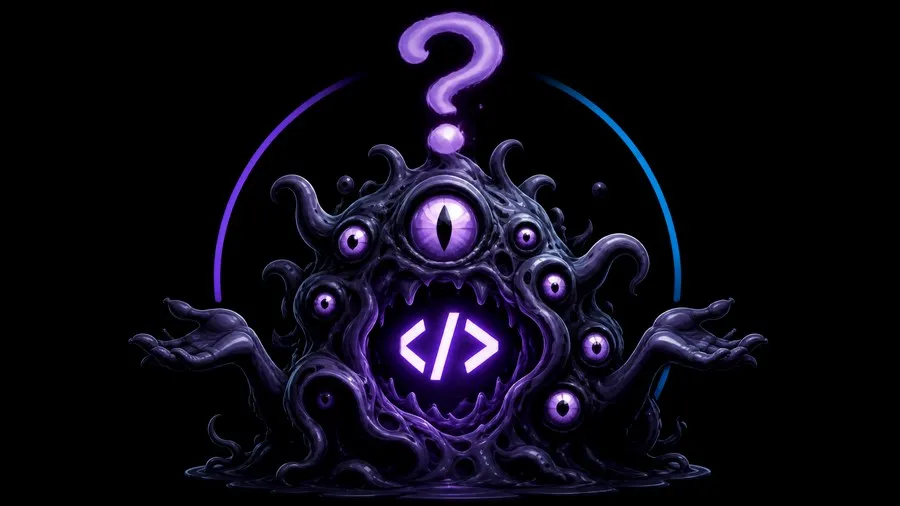
The shoggoth is the AI community's own metaphor for large language models — enormous, many-eyed, and much more useful with a good leash. Ours is house-trained: it builds on governed rails, and it never touches your bill.
Ask a person.
Pick a topic on the contact form and the right inbox gets it — sales, support, security, press or partners. If you would rather see the platform than read about it, book a demo and bring your use case.
Answers on this page are the same ones shown on the pricing, product, security and download pages — one source, so they never drift apart.
Bring us something you want built.
CodeMonster is invite only while we work directly with early adopters. Request an invite and we will meet, scope what you want to build, and get you productive. You bring the AI subscription you already pay for.